
How Alkimi Powers Onchain Advertising with the Sui Stack
A deep dive into how and why a decentralized ad platform is using Sui’s full stack to move a $750B industry onchain

Main Takeaways
- Alkimi is a live, enterprise advertising platform that runs auctions, delivery, verification, and settlement onchain for real advertisers and publishers.
- The Sui Stack is the infrastructure behind it, providing private execution, scalable data, verifiable outcomes, and enterprise-grade privacy in one integrated system.
- In production, Alkimi campaigns have delivered results such as a 34% lift in sales intent (Polestar) and a 68% reduction in cost per thousand impressions (AWS video).
- Together, Alkimi and the Sui Stack show how real-world economic systems can run onchain in production, not as experiments, but as scalable infrastructure.
Overview
Digital advertising is one of the largest commercial industries in the world, with total annual spend estimated at around $750 billion, yet much of its infrastructure still operates with limited transparency and inefficient settlement.
Advertisers struggle to verify where budgets go and whether campaigns actually deliver what was promised. Publishers face delayed payments, fragmented reporting, and complex reconciliation across multiple intermediaries.
In practice, both sides lose value through opaque fees, slow processes, and trust-based systems that are difficult to audit. Alkimi was built to address this.
Running Advertising Onchain
Alkimi operates a live, enterprise advertising platform that runs the core mechanics of digital advertising onchain.
By making outcomes provable and removing unnecessary intermediaries, it enables advertisers to get clearer performance for every dollar spent, while ensuring publishers are paid accurately and faster.
We examine why Alkimi moved onchain, why a single layer wasn’t sufficient, and how the Sui Stack enables a production-scale advertising platform to operate end to end. The result is a new operating model for how real economic systems run onchain.
Results in the Real World
This isn’t theoretical. Alkimi is already operating a live, revenue-generating advertising platform used by enterprise brands, agencies, and publishers.
This includes global organisations such as Coca-Cola, Dell, Cathay Pacific, Meta, Sky, Bupa, Kraken, PayPal, TikTok, and American Express. These companies are using Alkimi’s platform to run real campaigns with measurable business outcomes.
In practice, this has translated into concrete performance improvements.
For Polestar, a global electric vehicle brand running connected TV campaigns, Nielsen-verified results showed a 34% increase in sales intent, a 24% lift in brand association, 99% viewability, and a 96% video completion rate.
For AWS video campaigns, Alkimi delivered a 68% reduction in cost per thousand impressions (CPM) alongside a 19% increase in video completion rate.
What Changed in Practice
These results aren’t about better dashboards. They come from changing how the system works underneath. Because Alkimi runs auctions, delivery, and verification on the Sui Stack, advertisers and publishers see the same data at every step.
There’s no gap between what happened and what gets paid for. The result is less wasted spend, better optimisation, and outcomes that can be verified by both sides instead of taken on trust.
The Business Problem: Why Ad Tech Is Broken
Digital advertising runs on an enormous flow of transactions, but much of that activity takes place inside closed systems.
Advertisers spend billions each year with limited visibility into how budgets are allocated, what fees are applied, or how performance is calculated. Publishers, in turn, rely on fragmented reports and delayed settlement to understand what they are owed. This creates a structurally inefficient market.
A meaningful share of ad spend is difficult to trace across intermediaries, and limited transparency makes consistent reconciliation hard. The result is a system where disagreements are difficult to resolve because there is no shared, end-to-end record that all parties can independently verify.
For Alkimi, this was a systemic flaw. Solving it required rebuilding how execution, verification, and settlement work at a foundational level.
That rebuild led Alkimi onchain.
Why Onchain Changes the Model
Fixing these problems is not about new ad formats or better reporting tools. It requires changing how advertising transactions are recorded and settled.
Onchain systems introduce a shared execution and settlement layer where outcomes are recorded immutably, can be independently verified by all parties, and are settled automatically based on provable results.
For Alkimi, the case for going onchain was practical, not ideological. Auditability replaces blind trust. Verifiable execution replaces opaque reporting. And direct settlement between parties reduces the need for intermediaries.
In short, onchain infrastructure makes it possible to rebuild advertising around provable outcomes rather than closed systems.
Why Alkimi Chose Sui’s Full Stack
The Alkimi team initially built parts of the platform on Ethereum-based infrastructure.
This validated their core idea, but quickly exposed practical limits. Throughput was too low for enterprise workloads. Costs were unpredictable. And critical parts of the system still had to live offchain, stitched together through custom integrations.
To operate as a true onchain advertising platform, Alkimi needed an integrated system where the workflow could run end to end as a coordinated platform.
This is what led the team to Sui.
Rather than forcing enterprise workflows onto a single layer, the Sui Stack provides native support for private execution, scalable data handling, onchain verification, and confidentiality in one system.
This extended Alkimi's existing ad platform, enabling end-to-end encryption execution, verifiable outcomes, and direct settlement to a Layer 1, capabilities not available elsewhere without trade-offs in performance or privacy.
How the Sui Stack Powers Alkimi
Running a fully onchain advertising platform requires several things to exist at the same time. Execution must be private, data must scale, outcomes must be verifiable, and access must be controlled to meet enterprise privacy requirements.
The Sui Stack is designed around these exact constraints.
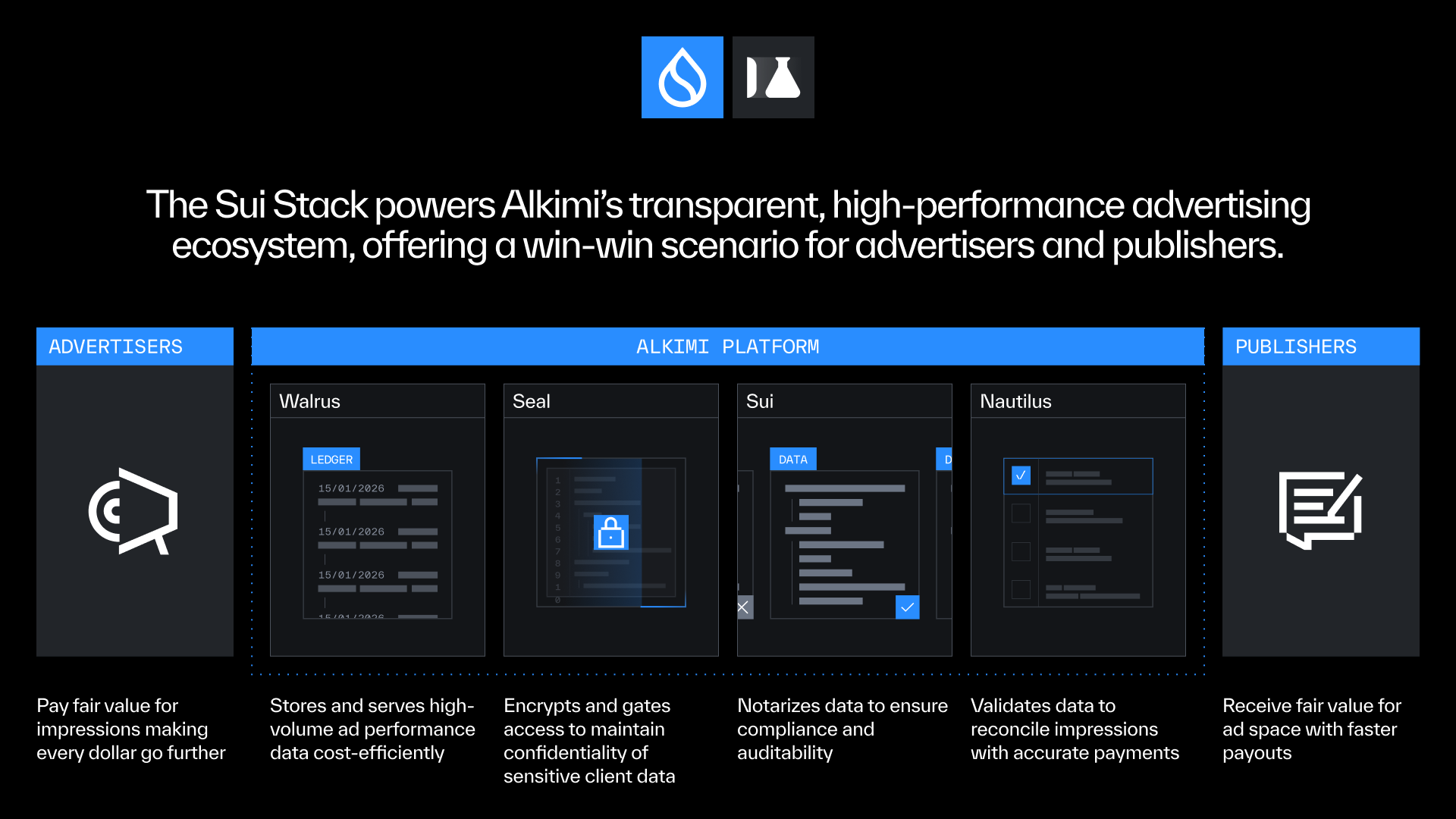
In practice, it is made up of coordinated layers that Alkimi uses together: a private execution layer (Nautilus), a scalable data layer (Walrus), a verification and settlement layer (Sui), and a privacy and access-control layer (Seal).
Rather than operating as separate tools, these layers function as a single system that allows Alkimi to run its advertising workflow onchain.
Nautilus: Private Execution
Nautilus runs Alkimi’s core advertising logic (auctions, delivery checks, financial reconciliation) inside secure Trusted Execution Environments. This allows sensitive computation to happen correctly without exposing proprietary business logic or raw campaign data, while still producing verifiable proof of what was executed.
Walrus: Scalable Data Layer
Walrus handles the large volumes of execution data generated by advertising activity. It allows Alkimi to store and manage this data at scale, keeping outcomes auditable and transparent without placing unnecessary load on the blockchain itself.
Sui: Verification and Settlement
Sui serves as the shared verification and settlement layer. Alkimi posts cryptographic proofs onchain so that advertisers and publishers can independently verify results and settle transactions based on provable outcomes rather than trust-based reporting.
Seal: Privacy and Access Control
Seal protects sensitive advertising metadata through encryption and access controls. This allows Alkimi to remain fully onchain while selectively disclosing data for audits or compliance, and meeting enterprise privacy requirements such as GDPR.
A Single Coordinated System
Nautilus, Walrus, Sui, and Seal operate as a single end-to-end system.
Each layer plays a distinct role, but Alkimi only works when private execution, scalable data, verification, and privacy are tightly integrated.
This is what makes Alkimi a full-stack implementation in practice.
Why This Matters
Alkimi is real-world proof of what the Sui Stack is designed to enable.
By moving the full advertising process onchain, Alkimi is changing how ad tech works in practice. Advertisers can see what they are paying for and verify that delivery is real. Publishers can see what they earned and get paid more reliably.
Both sides are working from the same data, rather than separate systems that don’t quite agree. That’s the real shift.
When results are visible and verifiable, less money disappears into hidden fees and middlemen, and it becomes easier for both sides to trust the system.
For builders, Alkimi shows that the Sui Stack can support real production systems with sensitive logic, large volumes of data, and real users, not just demos.
For enterprises, it shows that onchain infrastructure can run everyday business without slowing things down or exposing private information.
And for Sui, Alkimi demonstrates how the full stack comes together in practice. It shows that Sui is more than just a blockchain, but a platform for moving real-world economic systems onchain, in a way that actually works at production scale.
Learn more about the Alkimi × Sui partnership