
Beyond NFTs: A Strategic Framework for Blockchain Adoption in Gaming
From real-time rewards to provable fairness, games on Sui show how blockchain can enable mechanics that legacy infrastructure can’t support

Main Takeaways
- Web3 games succeed when they leverage blockchain to reshape game economies, not when it’s used only to tokenize assets.
- Sui’s performance and tooling support production-scale gaming economies, from sub-dollar rewards to onchain randomness and community ownership.
- Real adoption comes from games that solve concrete problems like payments, fairness, and rewards, without making blockchain a burden on the player experience.
Overview
Despite exploding onto the wider gaming scene in 2021, blockchain’s role in the gaming industry faces a fundamental challenge.
In the face of the transformative potential of programmable money, transparent economics, and decentralized ownership, most gaming initiatives in Web3 still default to the same narrow pitch: "your items/cosmetics/characters can be NFTs." The VCs may have loved this, but it has not yielded enough gamers, leaving developers and platforms struggling to identify genuine adoption opportunities.
The SuiPlay0X1 gaming handheld is a $599 bet that blockchain can transform gaming infrastructure. It embodies our belief that this technology does more than just tokenize a sword or a skin. Instead, it can fundamentally rewrite the way games are built and played. To get there, we have to move past "asset tokenization" and start leveraging blockchain’s unique ability to foster entirely new economic models and developer-led innovation.
The gaming industry is a nearly $200 billion powerhouse, yet the blockchain segment remains a small fraction of that ecosystem. This malaise is not without cause. We haven't yet proven to the average player that "play-to-earn" or "interoperable assets" make their experience better. In many cases, players are rightfully skeptical of anything that feels like it’s over-financializing their favorite pastime.
Our goal isn't to force crypto into games. It’s to use the unique speed and scalability of Sui to build features that are so seamless and beneficial that players don't even realize they're using a blockchain. They just know they're having more fun. By moving the complexity to the background, we allow the gameplay to take center stage.
A Framework for Strategic Blockchain Integration
Mysten Labs has seen a clear pattern emerge through our work with innovative studios and the launch of the SuiPlay0X1 in partnership with GameOS developer, Playtron. The most successful implementations don’t just "add" Web3 features to existing titles. Instead, they enable entirely new economic relationships and experiences between players, creators, and their communities.
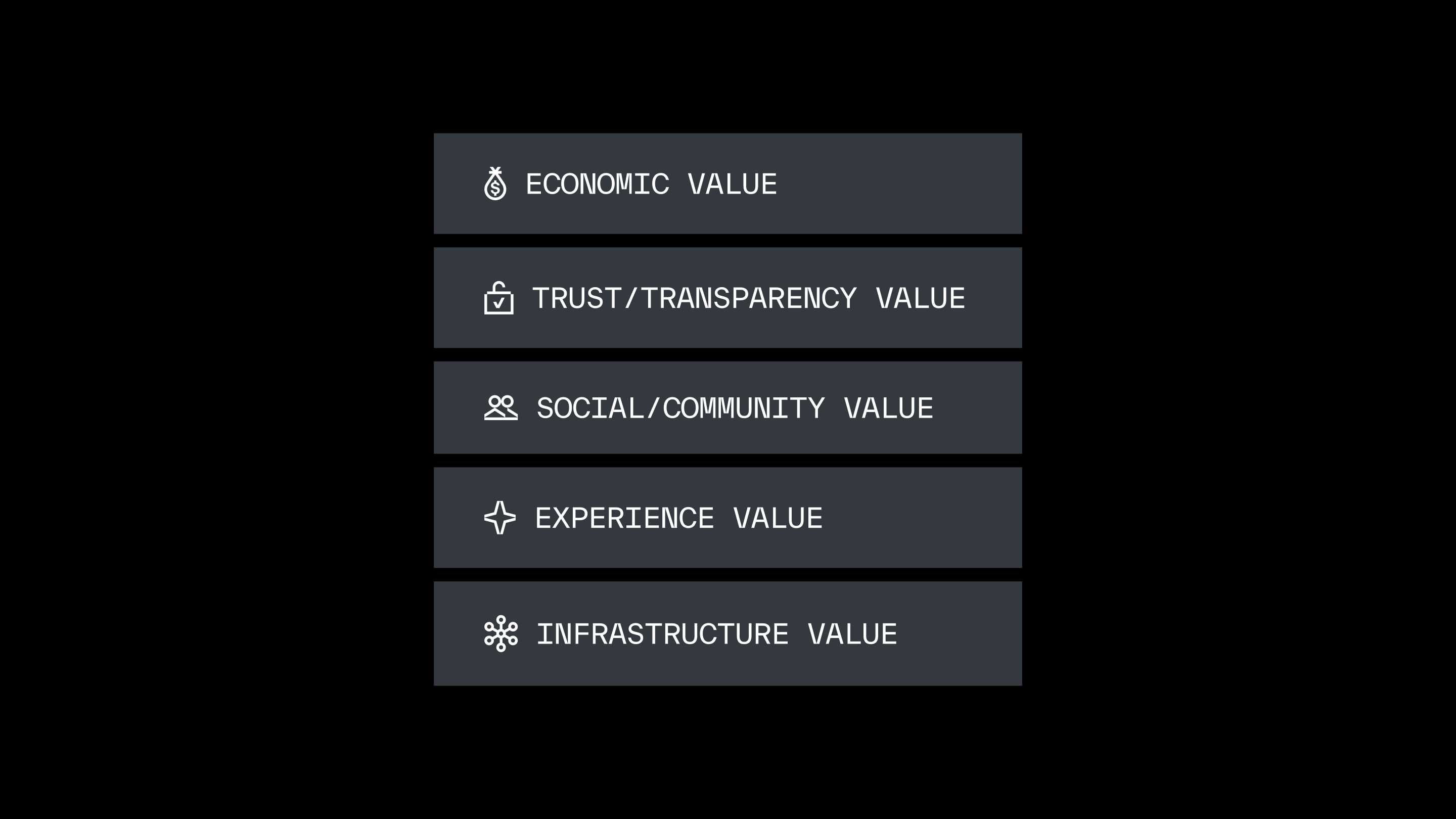
To help developers navigate this, we’ve developed a framework to identify the most impactful integration points:
Value Creation Types
Blockchain technology should solve problems or unlock new possibilities. We see these falling into five key categories:
1) Economic Value:
Blockchain introduces new revenue streams, automated payments, and global transaction capabilities that were previously out of reach.
Examples:
- Overtake, a Web2 game item trading marketplace, chose Sui to improve the economics and safety of their platform. Some examples of what they’ve taken advantage of on Sui:
- Global Micropayments: Economically viable sub-dollar transactions that allow players to trade even the smallest items without high fees.
- Programmatic Escrow: Creator service marketplaces that use smart contracts to ensure everyone gets paid fairly and automatically.
- UGC Revenue Sharing: Automated systems that reward user-generated content creators.
- Other economic examples include:
- Shared Success and Ownership: New models for community-funded development allow supporters to participate in a game’s economic journey, while true digital ownership ensures players have a tangible stake in the assets they’ve worked hard to earn.
2) Trust/Transparency Value:
In an era of "black box" algorithms, blockchain offers a way to build verifiable fairness directly into the game’s code.
Examples:
- Provably Fair Mechanics: Games like DoubleUp use Sui’s onchain randomness to ensure every outcome is transparent and unbiased.
- Economic Integrity: Transparent drop rates and economic parameters in expansive multiplayer games such as EVE Frontier.
- Integrity Systems: Onchain records provide a new foundation for verified tournament results and anti-cheat systems that players can actually trust.
3) Experience Value:
Technology should make things easier, not harder. We’re focused on using blockchain to remove friction and create a more cohesive gameplay experience.
Examples:
- Portable gaming identities, currencies, and/or assets across platforms and games
- Seamless cross-game social connections such as persistent guilds or friends lists
- Potential for reduced friction in payments and asset management
4) Infrastructure Value:
We believe the best tools are the ones that let developers focus on creativity rather than complexity. Blockchain provides a shared foundation that simplifies how games are built and managed. Providers of integrated blockchain technology simplify the process for games to incorporate Web3 mechanics. These mechanics include, but are not limited to:
- Beamable’s full-stack game services, including easy wallet integration and Unity and Unreal SDKs
- Venly’s ability to add Web3 functionality on top of existing game backends
- Potential for cross-game user acquisition, loyalty programs (e.g., Forge.gg and Snag) or shared monetization models
- Onchain player analytics and wallet data points
- Easy global payment rails such as Crossmint and SuiCoins
5) Social/Community Value:
At its heart, gaming is about connection. Blockchain allows for new models of collective ownership and governance:
Examples:
- Expansive multiplayer games like EVE Frontier benefit greatly from their community being able to directly participate in the creation and ownership of a game’s world and economy. In EVE Frontier’s case:
- Players can create and own Smart Assemblies – objects/systems in-game that other players can use, and that the creators can prosper from, both in-game and in real life.
- Founder Access (alpha) players can earn EVE Points for contributing to the early game’s iterations and growth.
- When launched, the $EVE token will be owned by players and serve as a core underpinning of the game’s economy.
- Other examples include:
- Community-owned game servers and infrastructure
- Player governance of game economies and rules
- Shared upside in gaming communities and content (when combined with the economic value ideas above)
Game Highlight: XOCIETY
The framework isn’t just theoretical; it is already being used by studios on Sui to redefine how they engage with their players. One popular Sui-based game, XOCIETY, illustrates how studios navigate these dimensions to create genuine value.
XOCIETY
XOCIETY is an extraction-based shooter with RPG and economic elements. Competitive shooter games face a fundamental challenge: traditional esports only rewards the top 0.1% of players, while the vast majority of players who invest thousands of hours receive nothing. By building on blockchain, XOCIETY can distribute prizes in real-time to thousands of players simultaneously – something that legacy payments simply can’t do efficiently for sub-dollar transactions.
The team has prioritized building Economic Value, focusing on a Single Game implementation. Built on Sui, XOCIETY distributes rewards to thousands of players simultaneously, in real-time, with no minimum thresholds. During testing, this has driven D+14 retention to 48%, far exceeding median retention benchmarks. As XOCIETY's team notes, "Once players realized their time and skill had real, onchain value, they became far more committed and invested in the experience."
Critically, XOCIETY makes the blockchain invisible. Players log in through the Epic Games Store, without needing to think about a wallet or understand private keys. Their "embedded wallet" implementation automatically creates and binds addresses in the background. As the team notes: "No one asks what cloud Netflix runs on. Blockchain should be the same."
XOCIETY's collaborations with Pudgy Penguins and adidas demonstrate programmable revenue sharing. Whenever a Penguin skin earns revenue in-game, the original NFT holder automatically receives a share. And whenever an in-game adidas wearable is purchased, part of that revenue is shared across adidas NFT holders. This economy is only feasible due to blockchain's programmable money infrastructure.
Common Patterns with XOCIETY
- Technology should be invisible: The game does not require users to understand the ins and outs of wallet creation or how provable random number generation (RNG) works. Success comes from delivering value seamlessly.
- Start with single-game value: They avoided the temptation of grand cross-game visions, focusing on making their individual games better first.
- Sui’s tools matter: XOCIETY leveraged tools unique to Sui to quickly enable the blockchain functionality needed for their games, whether zkLogin for seamless logins, or Kiosks for selling assets.
Enabling Developer Innovation
The framework's most important insight is that successful blockchain adoption in gaming happens when blockchain infrastructure enables developers to build experiences that were previously impossible, not when it simply tacks on blockchain features to existing games.
For Sui, we continue to focus on being essential infrastructure for gaming innovation, rather than just another blockchain seeking gaming applications. We’re enabling gaming developers to address their challenges around payments, community management, revenue sharing, and user acquisition. The most successful implementations will be invisible to players — they'll simply experience better games with more transparent economics and stronger community ownership.
By focusing on infrastructure that solves real developer and player problems, blockchain-powered gaming can move beyond the speculation cycles to create lasting value for the gaming industry and its communities.
For developers interested in building on Sui's gaming infrastructure, explore the documentation at docs.sui.io and join the developer community to discuss implementation strategies and technical integration approaches.